

Why Do We Follow Others?
Further thoughts on followership.

Author’s Note: This is my second installment on this topic. If you missed Part One, you may wish to go back and read it here.
The term “followership” has clearly evolved in the quarter century since I first encountered it as an MBA student at NYU Stern. Most of us today might think of social media followers as our current definition of the term. (My son’s soccer hero, Cristiano Ronaldo, may have the most social media followers in the world, with over 1 billion total followers across various social media platforms.
Yet, most of us will create more impact in our organizations if we focus on those who follow us personally, and naturally, by how we communicate on a more personal level through our writing and speaking. This aspect of natural followership is at the heart of the 2025 book I’m analyzing today, Christian Monö’s Why We Follow: Natural Followership in a World Obsessed with Leadership. I met Christian at a book fair I organized for my favorite coworking community, Shack 15. He was one of a dozen authors who shared their writing with fellow members back in May, and launched my summer reflection into the questions of who I follow (and why), as well as who follows me (and why).
Monö’s provocative work advocates for a more empowering role for those who choose to follow.
“Followership is a choice. While we can force a person into submission, we can never compel them to follow. It’s always the follower who decides whom they want to follow, when, and for how long.”
From a communication point of view, I work with many individuals who strive to be more confident and convincing. But I never want to coach clients to masquerade as great leaders with attractive qualities but little substance. I thrive when working with individuals who have great ideas, innovative breakthroughs, and fascinating technology. I help these individuals focus on enhancing their communication skills to convey their ideas with clarity and conviction. The heart of my coaching practice now centers on founders, physicians, and researchers striving to bring their innovative work to the attention of others. That’s also probably why I was so drawn to Monö’s work this summer.
Monö makes a clear distinction between those who truly lead and those who simply make decisions, often about where resources will be deployed. Similarly, he distinguishes those who are natural followers and those who are merely subordinates.
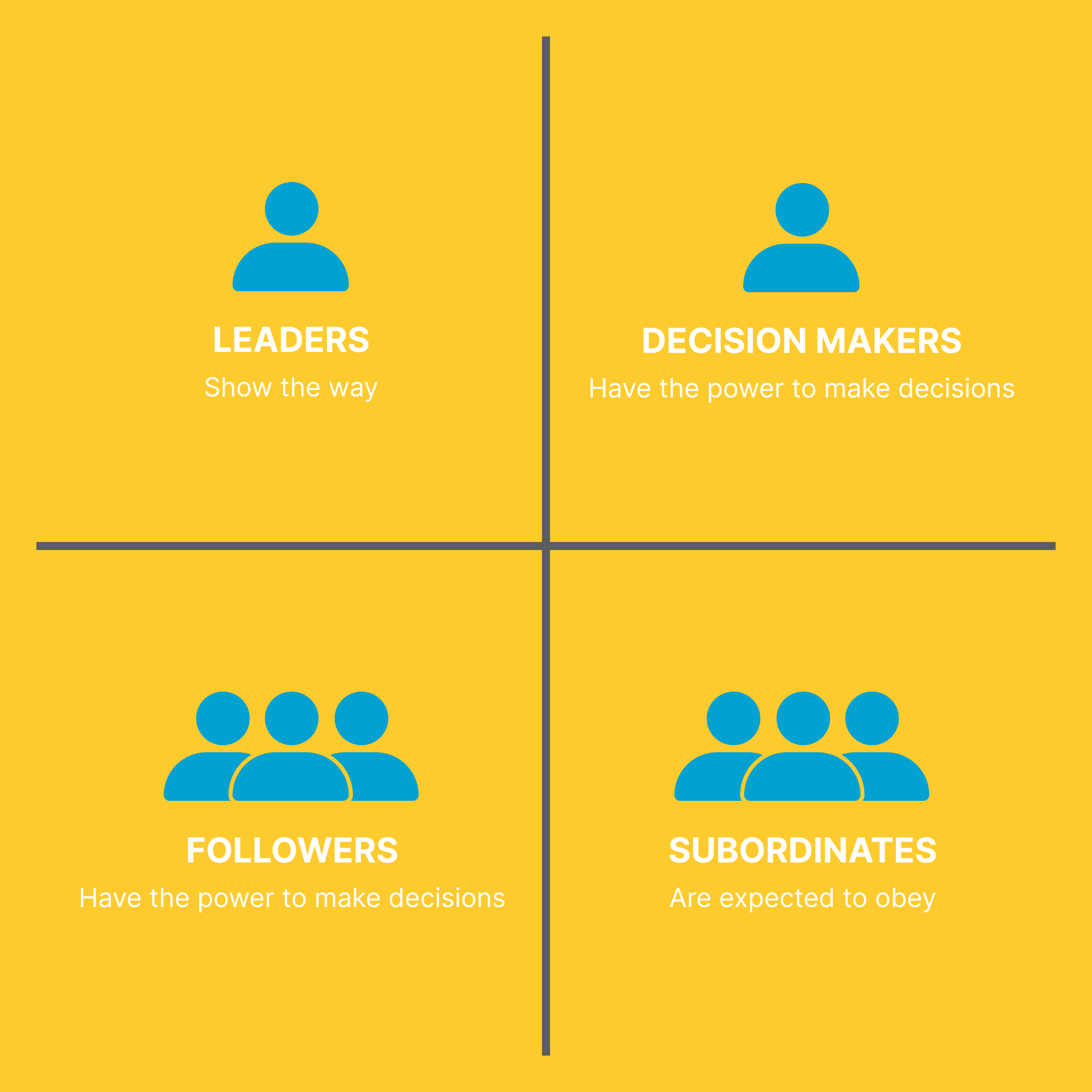
The simple 2-by-2 matrix above is enough to have me redefine my leadership and rethink followership. The goal today is not to try to coerce, manipulate, or demand that others follow my direction. Rather, it’s to become the type of leader that others choose to follow, for authentic reasons. My now deceased colleague Bill Meehan (1952-2023) and I used to wrestle with this idea when teaching Critical and Analytical Thinking (CAT) at Stanford’s Graduate School of Business. As a former McKinsey partner, he clearly articulated that it was not enough to be a great communicator or a great critical thinker. One must do both. Great thinking is expressed in clear communication; the two should feed one another.
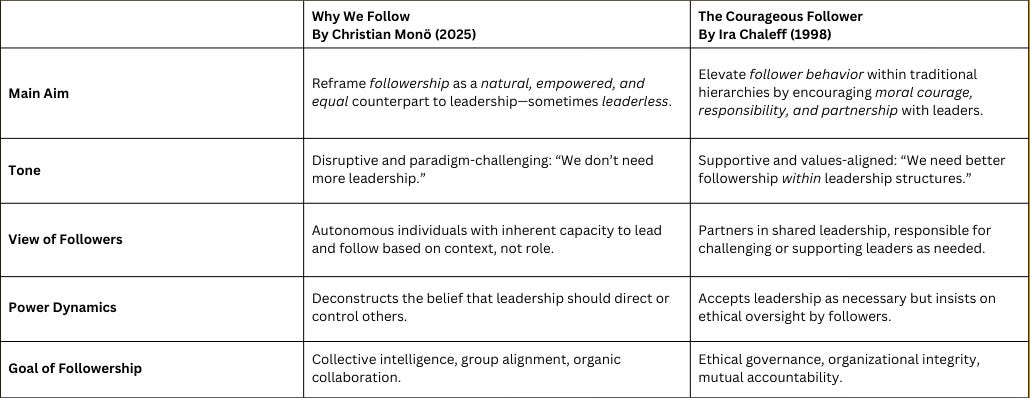
While I’d love to have you dig in deeper and read Monö’s book, maybe even go back in time and read Chaleff’s, my assistant and I crafted this table to compare the two books’ contribution.
So, why take two entire posts to focus on the unique dimensions and characteristics of followers? As a passionate advocate for effective leadership communication, this journey over the summer has been fascinating for me. I believe strongly if a client describes somebody with a leadership issue, it’s often a communication issue. And, conversely, if an individual is not communicating effectively, they are likely not leading well either.
If we can all broaden our approach to leadership and look at our use of “follower-centric” communication (I would say “audience-centric”), we will increase our mastery at both leadership and communication. Over the next few weeks, consider these questions:
If I heard this from another person, would I be compelled to follow them?
What matters most to those for whom I’m writing? Can I prioritize their needs over my own?
When are my needs met by another, which drives me to want to follow naturally?
As we prepare to transition from the pace of summer to that of autumn, this is a great thought experiment to consider. Let me know what unfolds for you.
Talk(s) of the week
This summer, I had the privilege of coaching four scientists who delivered one of the most challenging talks of their careers: seven minutes without notes or slides. These brief talks packed such inspiring content about their research and journeys. Below is the first talk by Dr. Jacqueline Campbell, founder of Asterisk Labs in the UK.
You can see the entire set of talks here on this playlist. Enjoy!
In July Comm Matters broke the 2500 subscribers mark and are consistently seeing over 2,000 views of each newsletter. I LOVE getting comments (below) and notes from readers. Please keep sharing this always free resource to those who you think would benefit from communicating with greater mastery.
JD’s Recommendations: what I’m reading, hearing, and seeing:
Reading: This week, check out my former student, Yiming Ma, who debuted his first novel, These Memories Do Not Belong to Us. I read it in 2 days!
Hearing: Thanks, Erin Thrope, for turning me on to All the Hacks with Chris Hutchins. This episode features a familiar voice sharing tips on spontaneous speaking.
Viewing: My ten-year-old daughter, Roma, has turned me on to the fascinating work by HTX Studio in China. Explore this delightful short video: We planted a crystal forest.
As we watch summer begin to slip into the sunset, I wish for each of you a change of pace as you end August. Whether that’s a 7-day road trip like Ken and I are taking with the kids, or simply finishing a book or project you’ve been putting off, may August bring you something different than you’ve seen so far in 2025. Wishing you nothing but the best…jds
"I believe strongly if a client describes somebody with a leadership issue, it’s often a communication issue. And, conversely, if an individual is not communicating effectively, they are likely not leading well either."
Communication skills and effectiveness are considered natural yet that it is a skill that requires constant development. We just don't realize the troubles that result from sub-standard or deficient communications.
I get SO much from your posts, JD. Can’t wait to check out some of these resources.