

Making Networking Effective
Even when you may not feel up to it.

Most people imagine that since I specialize in communications and am pretty clearly an extrovert that I must love networking events. That’s not the truth. I endure networking events because they are a necessary part of life but are usually not activities that I relish attending. That changed for me a bit last Thursday night when I attended a networking event sponsored by the University of Pennsylvania at their San Francisco campus, Wharton West. As we enter this season of holiday gatherings and opportunities to connect and network, let me share what made it different, and some strategies for effective networking for those who don’t like to network.

I don’t attend many Penn events and don’t feel very connected to my Alma Mater, where I earned my doctorate in 2012. As I got closer to the start of the evening, there were several points where I nearly backed out. In fact, if my laptop had been in the car, I might have just hung out at Starbucks and worked on some tasks for a couple of hours while someone watched the kids. I’m so glad I didn’t. I chose to walk through the doors and join the event.
I was surprised to be greeted by name the moment I arrived. One of my peers in the doctoral program, Hoopes Wampler, who is now a Senior Associate VP of Alumni Affairs, saw me walk in and called me by name. I did not expect that. It began the evening on a high note.
What made this event different was the intentional design and ease of connection that the organizers created. The evening never felt forced and conversation flowed nicely. There are a few items that the organizers included that did not show up as gimmicks, but rather as easy access points for conversations with strangers.
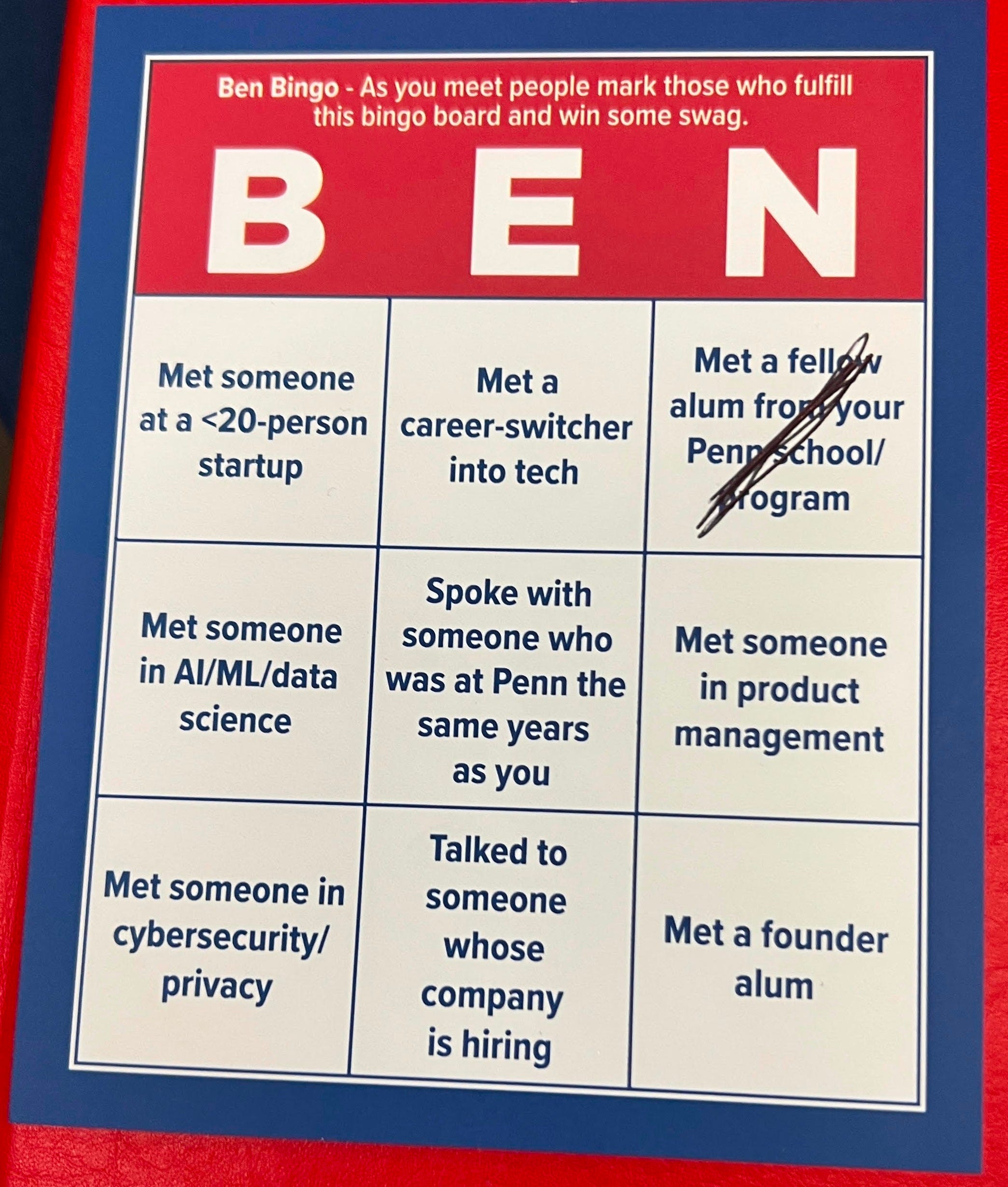
The first was a simple 3 X 5 card, pictured below, and the chance to cross off three in a row and be eligible for a door prize. It surprised me that this made that much of a difference, but it was a fun and easy way to connect with strangers. It opened conversations and laughter without feeling like a demand to participate. (I will note that I did complete my card, but didn’t win the door prize.)
Another simple tactic they used was to add conversation starters to your name tag, like, “Ask me about my pet.” Or “Ask me about a recent podcast I listened to that changed my life.” Maybe half the crowd put on these stickers, and it made it easy, but not demanding, that we participate.
During the 45 minutes we were given to mingle, I positioned myself at a table by myself, enjoying a few of the wonderful hors d’oeuvres. A few alumni joined me shortly. We were then joined by some students in the Executive MBA program. Conversations flowed easily. Some asked about the stickers on our badges. Others, like me, were trying to fill out their tic-tac-toe board. No one ever pulled out a business card. (Okay, that might also be generational; many people under 40 don’t carry business cards.) As we were separating, a few of us decided to connect on LinkedIn, which felt like a natural next step in the conversation, not some sales pitch to find each other and do future business.

I had one conversation with an EMBA student whose communication professor I knew. We snapped a selfie to send to her, letting her know we had met. As the event was about to start, I made my way to the auditorium, sitting next to someone I had met just moments earlier. It provided a chance for a longer conversation.
The program started and ended on time. The moderator kept things light, comfortable and playful. It was not an evening that emphasized content but rather experience, fostering organic conversations among us about our experiences. No party games. No “Tell me more about yourself.” Driving home, I reflected on specific communication strategies that I can offer to my readers when they find themselves at a networking event.
Attend with an open mind. Be curious about those you meet and ask thoughtful questions. Allow others to speak more than you do.
In conversations, seek quality, not quantity. In Susan Cain’s book, Quiet: The Power of Introverts in a World That Just Can’t Stop Talking, she offers tips for introverts at networking functions. She advises setting a low goal of how many new people to meet. Once that’s met, give yourself permission to leave. While I am not an introvert, I felt accomplished after having three deep conversations of connection.
Follow up with clear intentions. I struggle with following up after events like this. I feel the need for ROI from attending such events, rather than spending more time with my kids. I try to limit my follow-up to just a few contacts and make it intentional, like sharing a TED Talk, podcast, or blog post relevant to our conversation. I don’t need to invite people to coffee or encourage them to subscribe to my newsletter. I only need to be of service to those I meet, opening opportunities for future conversations.
Drop a note in the discussion below and let me know other tactics you deploy when facing the task (or opportunity) to network with others.

Think Fast Talk Smart Learning Community – Book Club: On Dec 11th at 8 AM Pacific, I’ll be part of a live discussion of my book, Communicate with Mastery, hosted inside the Think Fast Talk Smart Learning Community (If you join before January 2nd, your first month is free). Regular readers know how often I link to Matt’s books and talks, come join us for this conversation.
As we close out the year, I’m struck by a quiet milestone: this newsletter marks our 75th issue. When I first began writing these posts, my hope was simply to offer a useful nudge or a fresh lens for those committed to clearer, more intentional communication. To shape where we go next, and ensure these notes continue to serve you well, I’d love your perspective. Below is a brief survey to help guide the topics and formats we explore in 2026.
Dear Reader: Please take a moment to help us make Communications Matters better!
Talk of the Week
At a McDonald’s PlayPlace, Matthew Dicks found himself in a spot to which any parent can relate: his son stuck high in a plastic tube, while his daughter below hesitates. His story offers unexpected courage and sibling connection. This proves even more poignant in retrospect, four years later, as his daughter is diagnosed with autism … offering insight into her unique perspective and quiet brilliance.
JD’s Recommendations: What I’m Reading, Hearing, and Viewing
Reading: Collin Wallace’s Substack post offers a heartfelt tribute to two remarkable GSB colleagues, Joel Peterson and Jon Bendor, at their passing.
Hearing: For those of us who celebrate the season, Clio Briggs’ performance of Christmas Lullaby is a personal favorite of mine—a beautiful interpretation of Jason Robert Brown’s touching song.
Viewing: Lisa Bloom’s podcast The Story is All There Is recently came to a close. Their farewell episode is a thoughtful, engaging sendoff, celebrating stories that linger long after they’re told.
As we enter this season of holiday gatherings and opportunities to connect and network, I invite you to test these strategies. See what works for you as you look to relate with authenticity and an openness to what unfolds.
Drop a note in the chat below if you have other networking strategies. I’d especially like to hear from those of you who don’t like to network.
All the best,
jds
Thoughtful design solves so many problems!